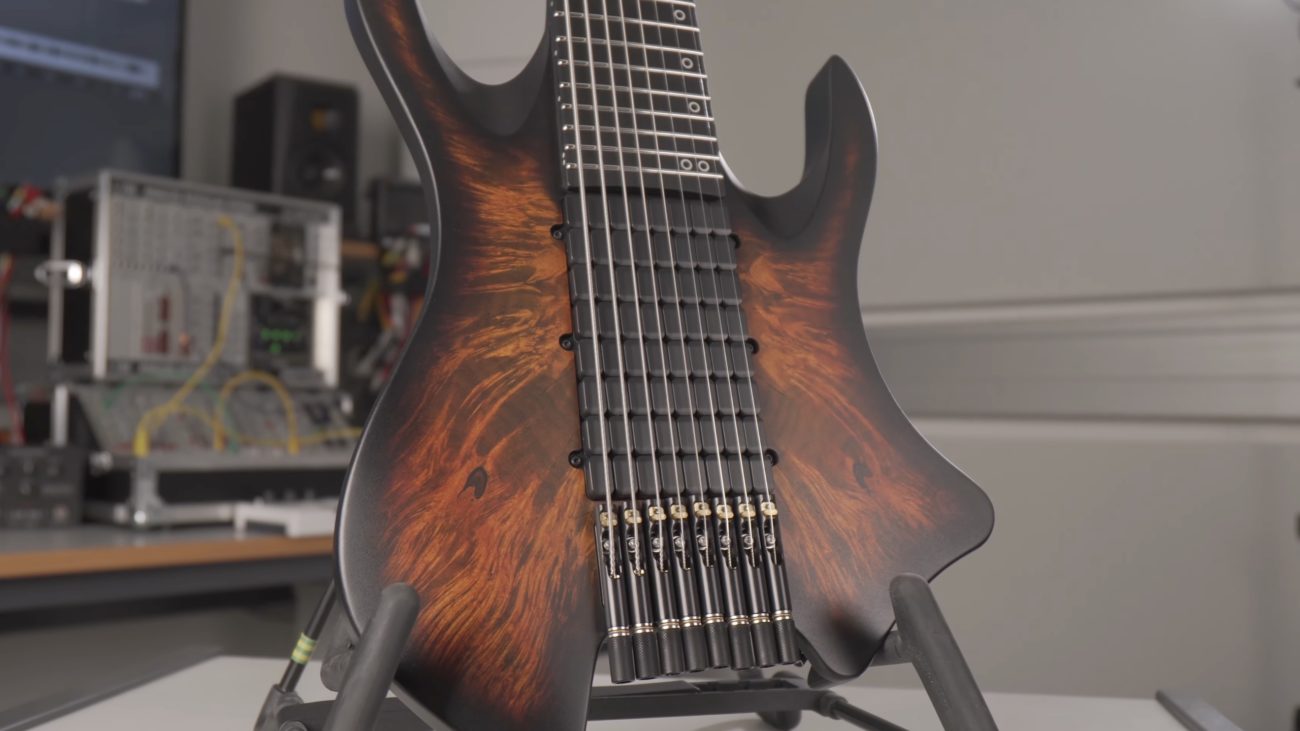
Oh sorry, you’re still using pickups that can only do one thing at a time? That’s cute. David Wieland recently entered his PolyMap pickup system into the AES Student Design Competition 2026, and it offers up a whopping 64 total options across the strings.
“Traditional electric guitars have two or three pickups andyou have to decide while playing which ones are active,” said Wieland in the below video as a kind of intro.
“This can limit what is possible with the playing, which is why I developed Polymap. It’s a polyonic guitar pickup system that detects each string individually at eight different locations. Then in software, you can decide which pickups are active, how they are blended, as well as apply various effects.”
He continued: “This project is my master’s thesis and I did everything from building a guitar from wood, designing all the custom electronics, assembling them, as well as writing a custom control software plugin.”
And before we get into the nitty gritty of how this words, no – it’s not for sale. Wieland notes in his below video that making this as it is would cost several thousand dollars, and right now it could run people around $2,000.
Which we’ll find out when it finally goes to market, which it hasn’t: “I would say at the very least six months until we can even talk about how the final system looks, and probably it’s going to be next year by the time it is possibly available,” he said.
Alright, so what is this anyway? According to Wieland himself, PolyMap is a 64-channel polyphonic pickup system built as an 8×8 grid, sampling each string at eight distinct positions simultaneously. It transforms the guitar from a single-output instrument into a spatially aware data source.
To make this concept viable, PolyMap required an unusually deep signal chain. Sixty-four active pickups feed into buffered, bandwidth-controlled analog stages before hitting eight multi-channel ADCs.
From there, an FPGA aggregates and encodes the data into a MADI stream, which exits the instrument over a single coax cable – power included. The same cable carries both 12 V DC power and high-speed digital audio, eliminating batteries and simplifying connectivity in one move.
The use of MADI allows PolyMap to transmit all 64 channels at 24-bit/48 kHz with rock-solid timing – critical when phase relationships between pickup positions become part of the sound design.
A custom plugin – currently optimized for Reaper – acts as the control center, transforming raw multichannel data into a playable, sculptable instrument.
Two main modes define the experience. Manual Mode gives you surgical control over every pickup: level, phase, pan, and even micro-delay. Virtual Pickup Mode, on the other hand, abstracts the complexity, letting you “slide” a virtual pickup along each string, with the system blending adjacent sensors in real time.
And because the pickups themselves are wideband and flat-response, traditional tone shaping is moved downstream. Want the resonant peak of a vintage passive pickup? Dial it in after the fact. Prefer pristine, extended bandwidth? Leave it untouched.
Delay and diffusion effects take on a new dimension as well. By blending multiple pickup positions with slight timing offsets, PolyMap creates echo-like smearing that alters both timing and timbre. Then there’s split processing. Low strings can feed a bass rig while high strings hit a guitar amp, all from a single performance.
Even phase relationships become a creative tool. Blending inverted signals from different positions lets you sculpt harmonic emphasis in ways that feel closer to synthesis than traditional guitar tone shaping.
For a system this complex, latency could have killed the concept outright. Instead, PolyMap delivers impressively tight performance. End-to-end latency clocks in at around 5.4 ms with a 32-sample buffer – competitive with, and in some cases better than, standard audio interfaces. The hardware itself contributes only about five samples, with most delay coming from the DAW and operating system.
The source material for the hardware, FPGA logic, as well as software plugin is available on GitHub via Wieland right here.
Now it’s time for my personal opinion on this, because why not? You’re here, I’m here, we’re all nerds.
I want this, long story short. The PolyMap instantly unlocks some utterly insane potential that you’re never going to get with a traditional guitar. My first actual thought upon seeing this was “couldn’t you just keep tracking to achieve a similar effect?”
And I guess you could, but that’s a pain in the ass and you’re never going to get as you’ll get by having the exact same take across a ton of effects per string. Plus, having a bunch of effects per string also means you’re going to think about what you’re playing differently – something you probably wouldn’t if you just kept overdubbing.
Anyway, this is sick and I hope it goes to market. And I hope I can afford it, but that’s a me-specific problem.