For more than a decade, the original Strymon TimeLine has been one of the defining delay pedals on professional pedalboards, prized for its studio-quality sound, deep editing capabilities, and remarkable versatility.
With the TimeLine MX, Strymon has reimagined it as its most powerful delay workstation yet. Combining 12 independent effects engines, dual-engine processing, an all-new reverb algorithm, expanded routing options, and a significantly upgraded stereo looper, the TimeLine MX pushes well beyond conventional delay.
Two Engines Are Better Than One
The biggest leap forward is dual-engine processing. The TimeLine MX lets players combine any two engines simultaneously, routing them in Series, Parallel, or Split configurations with independent stereo panning.
Want to stack a Tape echo into a lush Reverb? Blend a Reverse delay alongside pristine Digital repeats? Or create sprawling stereo textures using different effects on each side of the signal? The TimeLine MX makes it possible without additional hardware.
Global Swell and Duck processing further expand its expressive capabilities, allowing delays and reverbs to bloom naturally around your playing or intelligently step back while you perform.
Twelve Engines, One Pedal
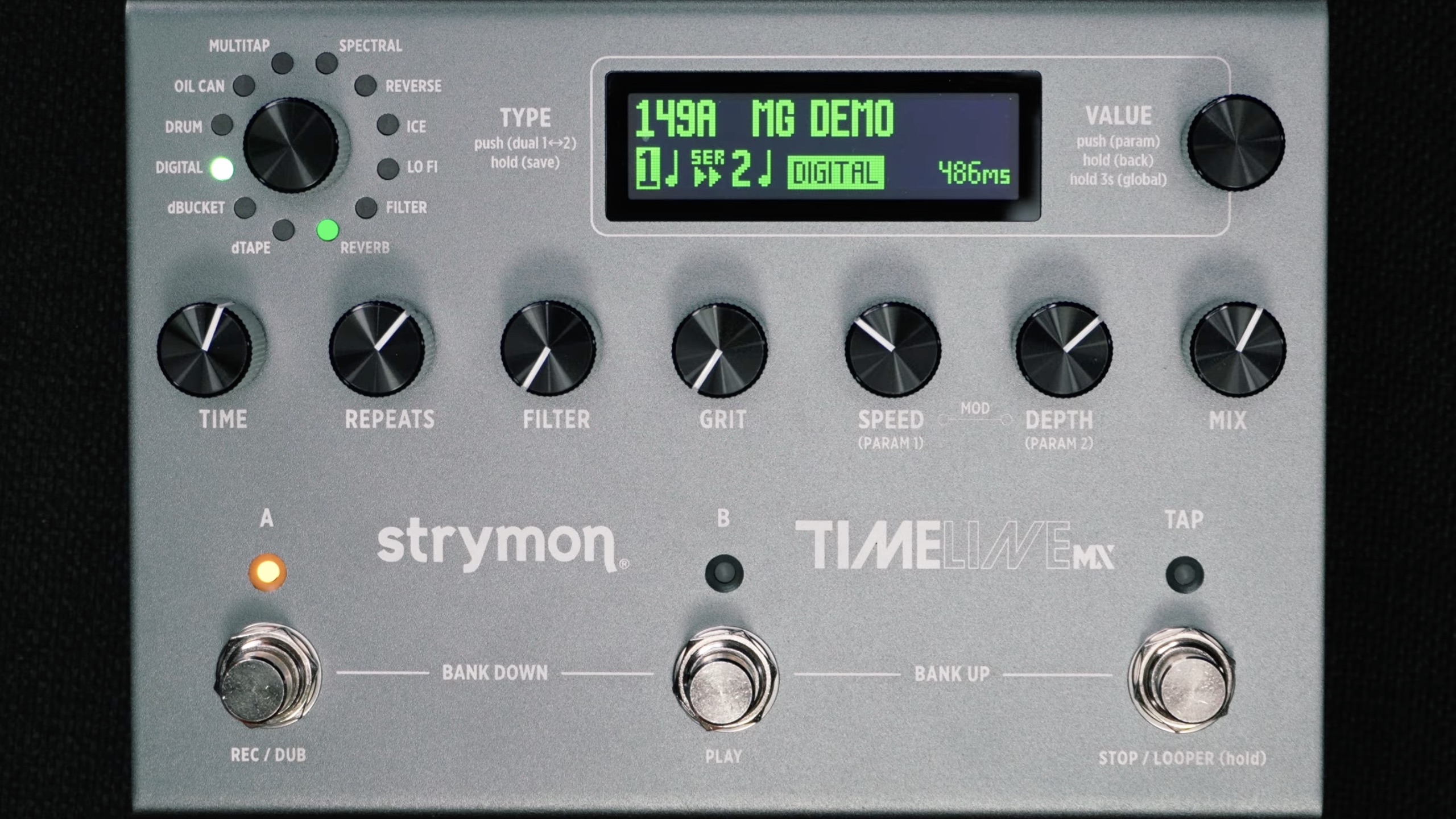
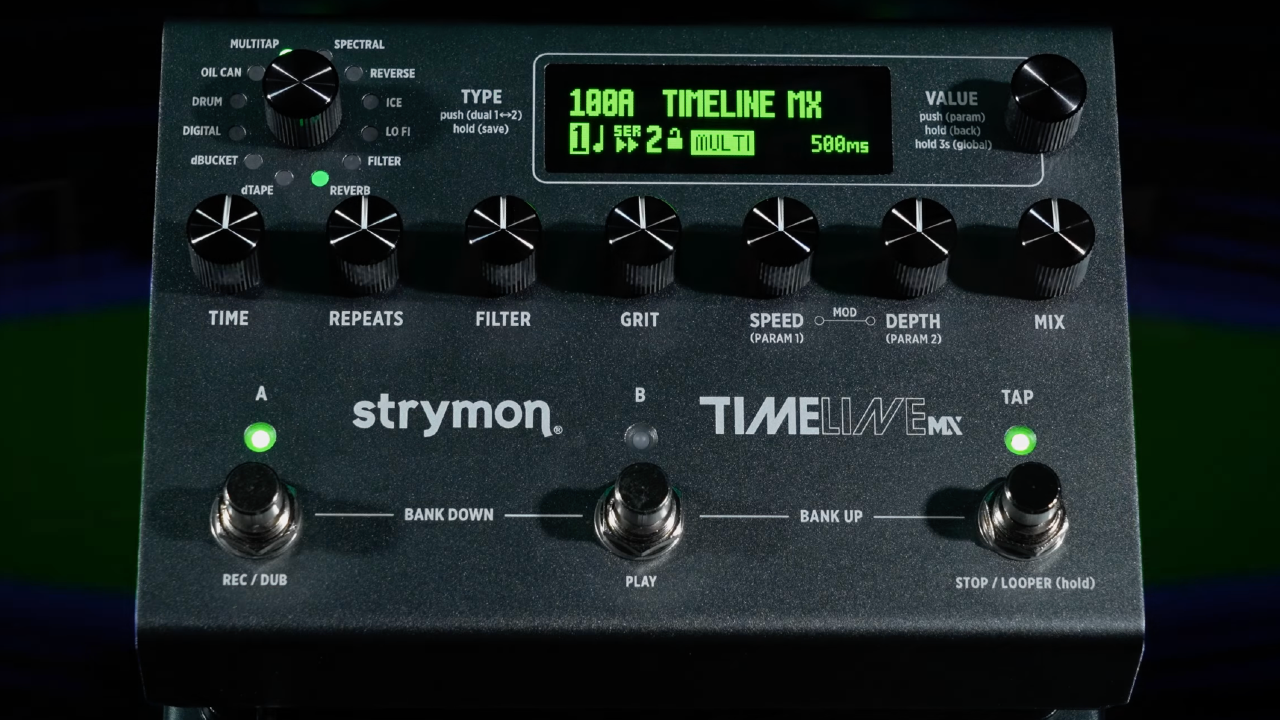
The TimeLine MX’s expanded engine library spans everything from classic delay sounds to experimental ambient processing.
Traditional favorites including Digital, dTape, dBucket, Drum, Oil Can, Reverse, Ice, Lo Fi, and Filter provide a broad palette of familiar textures, while the Multitap engine offers eight independently adjustable delay taps with individual control over level, stereo placement, feedback, and filtering.
The standout newcomer is Spectral, a granular processing engine that ventures far beyond traditional delay. Incorporating pitch shifting, reverse playback, time-stretching, and filtering, it transforms incoming notes into evolving textures ideal for cinematic soundscapes and experimental compositions.
Equally significant is the dedicated Reverb engine. Capable of everything from intimate room ambience to vast atmospheric washes, it adds a Grit control for extra character alongside optional tremolo modulation inspired by Strymon’s acclaimed Flint pedal.
A Serious Looper Upgrade
Looping capabilities have also received a substantial upgrade. The onboard stereo looper now offers up to five minutes of recording time and supports either multi-button or simplified single-button operation.
Players can also position the looper before or after the delay engines, determining whether recorded phrases are processed by subsequent effects or remain untouched while new layers pass through the pedal’s processing.
Built for the Modern Rig
The TimeLine MX is equally at home on traditional pedalboards and advanced MIDI-controlled systems.
Selectable stereo input and output configurations include conventional stereo operation alongside Wet/Dry and Wet/Dry/Wet routing. An analog dry path keeps the unaffected signal free from digital conversion and latency, while users can choose between True Bypass and Buffered Bypass to suit their setup.
Under the hood, Strymon has equipped the pedal with 24-bit/96kHz converters, 32-bit floating-point processing, and an 800MHz tri-core ARM processor, providing the horsepower needed for complex dual-engine processing without compromising audio quality.
Comprehensive MIDI connectivity is available via USB-C, TRS, and traditional 5-pin DIN, making integration into sophisticated live or studio rigs straightforward.
Get the Strymon TimeLine MX at one of the links below for $679: